AI & Data
Why I Switched from Cursor to Windsurf
A short note on why I moved off Cursor after several months, and how the Windsurf plus Claude Code setup actually works day to day.
Agentic AI Workflows : Why I Switched from Cursor to Windsurf (and How I Actually Use It with Claude Code)
I’ve been writing about agentic coding workflows for a while now, mostly centered on Claude Code as the heavy-lifting brain. The IDE around it has always been the supporting actor — and for the last several months, that role was played by Cursor. Recently, I switched to Windsurf. This is a short note on why, and how the setup actually works day to day.
What pushed me off Cursor
It wasn’t a single dealbreaker. It was a stack of small frictions that added up:
- Pricing got harder to reason about. In June 2025, Cursor moved its $20 Pro plan from “500 fast requests per month” to a usage-based credit pool tied to API costs. The intent made sense — heavier models genuinely cost more — but the rollout was rough enough that CEO Michael Truell publicly apologized and offered refunds. Multiple post-mortems estimated the effective request count dropped from ~500 to ~225 at the same price point. Once I was already paying separately for Claude Code, I didn’t want a second metered AI bill where the meter could surprise me.
- The agent felt redundant. Once Claude Code became my default for any multi-file or genuinely agentic task, Cursor’s own agent (now Composer 2 in Cursor 3) was doing work I didn’t want it to do. I was paying twice for overlapping capability.
- The SpaceX deal. This week’s news that SpaceX has secured an option to acquire Cursor for $60 billion later this year — or pay $10 billion for a strategic partnership instead — was the final nudge. The plan is to combine Cursor with SpaceX’s Colossus supercomputer (the xAI compute cluster Cursor is already renting from to train its in-house Composer models). The direction of travel is clear: Cursor’s model stack will tilt toward xAI/Grok over time, even as I’m primarily there to use Claude and GPT models. If my agent of choice is Claude, I’d rather sit in a tool whose incentives stay aligned with that.
None of these are fatal on their own. Together, they were enough to make me try the alternative.
Why Windsurf, specifically
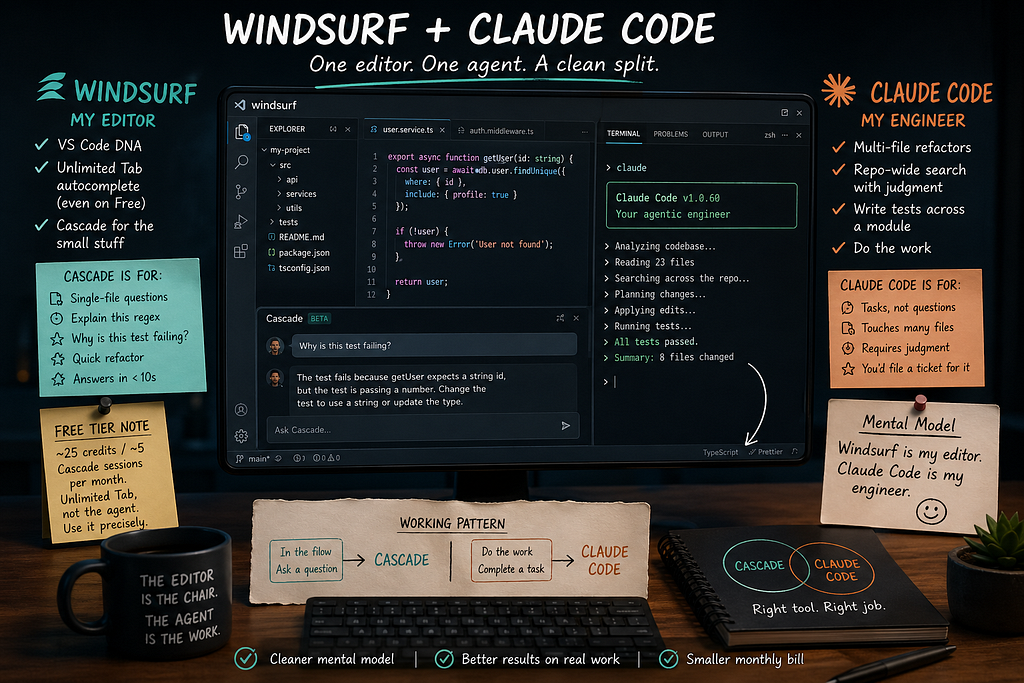
With Claude Code handling the agentic work, I didn’t need a premium IDE agent — I needed a competent editor with decent inline help. Windsurf gives me that: Cascade (their agent/chat) for the small stuff, unlimited Tab autocomplete on every plan including Free, and standard VS Code DNA underneath so nothing about the editor itself needed relearning.
Worth knowing: Windsurf was acquired by Cognition AI (the team behind Devin) in December 2025 for roughly $250 million, after an OpenAI bid collapsed and Google poached the original founding team in a separate licensing deal. So this isn’t quite the scrappy Codeium of 2024 anymore — it’s now part of a larger agentic-coding stack with its own roadmap. Whether that’s good or bad depends on how cleanly Cognition merges Windsurf and Devin over time. For now, the day-to-day product still works the way it always has.
The mental model that made it click: Windsurf is my editor, Claude Code is my engineer.
How the setup actually works
My working pattern has settled into a clean split:
Cascade handles the in-the-flow work. Single-file questions, “explain this regex,” “why is this test failing,” quick refactors of a function I’m staring at. Things where I want an answer in under ten seconds without leaving the file. Worth being honest about the free tier here: the Cascade allowance is genuinely tight — public estimates put it around 25 credits or roughly 5 Cascade sessions per month, with the unlimited part being Tab completion, not the agent. So I treat Cascade as a precision tool, not a workhorse.
Claude Code handles everything else. Multi-file refactors, anything that touches more than two directories, repo-wide search-and-replace with judgment, writing tests across a module, anything I’d describe as “a task” rather than “a question.” I run it in Windsurf’s integrated terminal, so its edits show up live in the editor — same project, two different operators.
This split has a nice property: I never wonder which tool to reach for. If I’d ask a colleague over Slack, that’s Cascade. If I’d file a ticket for it, that’s Claude Code. And because Cascade’s free quota is small, I’m never tempted to lean on it for work that should go to Claude Code anyway.
What I lost, what I gained
I lost some of the polish around Cursor’s tab completion — Cursor’s Tab predictions are still, in my experience, slightly better at guessing the next edit. Windsurf’s Tab is unlimited and free, but a notch behind on suggestion quality.
What I gained was a cleaner mental model and a smaller monthly bill. My agentic budget now sits in one place (Claude) instead of being split across two overlapping subscriptions. And because the free Cascade quota is strict, I default to Claude Code for anything non-trivial — which, it turns out, produces better results than letting an in-editor agent improvise across files.
If you’re considering the switch
The honest answer: try it for a week before committing. Install Windsurf, keep Cursor around, and see which one you instinctively reach for. If you’re already running Claude Code, my guess is you’ll find — like I did — that you were paying for two agents and only really using one.
The editor is the chair. The agent is the work. Pick the chair you like sitting in, and put the engineer somewhere you can talk to them.
This article is also published on Medium.